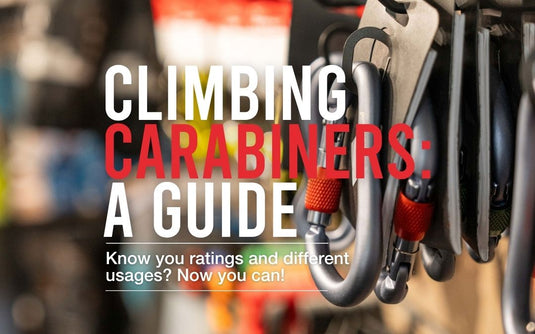
Climbing Carabiners: A Complete Guide
Feeling crabby? Don’t worry, we have a guide for you!
There are quite a few different types, different ratings and an even more dizzying array of colours, so we’ve put together a little guide to help you stay safe while climbing and get the right gear.
You can see our full range of carabiners here.
1. Beating the Jargon
To help understand carabiners, it’s important to cut through the gargon! Find below a little glossary of important terms.

Gate
The moving arm of the carabiner that opens so you can hook gear and items onto the carabiner.
Nose
The hook that connects to the gate arm and is hooked over to loop.
Basket (Rope Basket)
The curved top of the carabiner next to the nose.
Spine
The solid back of the carabiner that connects to the top and bottom and runs opposite to the gate.
Crotch / Runner End
The curved end that connects the joint of the gate and the back spine.
Gear Opening
The dead space created when the gate opens.
Cross Loading
Stressing a carabiner in the wrong orientation. This normally happens when a biner slips out of the right position and spins, and can cause it to fail.
2. What Does a Rated Carabiner Mean?
Carabiners are measured in KiloNewtons. This is a unit of force measurement and is the rate of force needed to accelerate 1000 kilograms at a rate of 1 meter per second squared.
Carabiners are measured along the major axis (the basket to the crotch) and across the minor axis (90 degrees to the major axis) to show how much force they can withstand. From a practical standpoint, what does this all mean?
Basically, as long as it’s got a rating written along the spine for the major axis with a minimum of 20kn, and with a CE Mark (‘Conformite Europeenne’ or European Conformity), it is classified as a rated carabiner.
Carabiners can also have a UIAA certification from the International Climbing and Mountaineering Foundation. Carabiners that meet all these criteria are the gold standard for climbing.
We would always recommend purchasing all gear from a reputable retailer and avoiding purchasing second-hand unless you can guarantee it is genuine. Astonishingly, there are counterfeit carabiners out there, and they do look very real, CE marks and all!
3. What Should I Use Them For?
There are many, many different ways you can use carabiners in climbing. The main ways are for anchors, belaying, racking gear, quickdraws and as general accessories.
All these different uses require different things from the biners, so they are all made in different shapes with different gates.
So, what do all the gates mean?

Screwgate
The most common type used for belaying and when a locking carabiner (a carabiner that locks into place so it can't be opened without another action taking place) is needed. These have a twisting piece of metal that moves up and down the gate to secure the carabiner in place.
Twistlock
Sometimes also referred to as locksafe, this type of gate pulls down and twists to open, and then snaps back into place once you let go to quickly lock the carabiner. These are ideal for use with children as they guarantee the biner is locked straight away, although they can be tricky to open.
Solidgate
The default for any Screwgate or Twistlock carabiner, but can also be found in racking (putting gear onto a harness or sling when trad climbing) and quickdraw carabiners. It simply means that the gate is a solid single piece of metal.
Wire Gate
This is a single piece of wire that forms the gate. Often found where you need a lightweight carabiner, such as a quickdraw or when racking.
Straight Gate
The straight gate is normally the standard for carabiners that have a screwgate lock or a twistlock, along with the default for a top quickdraw carabiner, and it means the gate is a straight line.
Bent Gate
The bend in the gate is designed to help when putting a rope into the gate, and is as it is described with a slightly bent or shaped gate. It is usually used at the bottom of a quickdraw or for a racking carabiner where you need to be able to quickly and effectively loop something into it. These can be in a wire gate or a solid gate form.
If we can understand the shape and the type of gate, we can select the correct carabiner for what we need it for. Below are the common types of carabiners. You can get others as well for accessories and not for climbing, such as hearts or even stars! But for climbing, the main types are:

D Shape
Perfect for anchors or for anything where the load will be a perfect line of weight from top to bottom, such as using a connect adjust. The D shape has a long, straight spine with almost equal angles at the top and bottom. If you hold it up, you can see the clear D shape.
Oval
A perfectly symmetrical oval shape, these are perfect for hauling on a pulley like a fixe, but also for racking, so gear can easily slip around and be found while on the wall.
Pear Shape
Shaped with a small end and a wide top edge. Perfect for connecting to multiple items, as the small end stops the top end from moving and cross-loading, but still gives space. These are the best options for belaying, and many offer a version with a barrier or bar at the smaller end to stop cross-loading when belaying with the small end attaching to the harness.
Wide Opening
Often used for High rope work, setting or hauling, these are designed so the gate can open super wide to allow more to be put on the carabiner.
We would always recommend chatting to our staff team about what you intend to use a carabiner for and looking at the manufacturer's website, as well as the retailer, to give the certification, as well as its intended use.
These guidelines are designed to keep you safe and make sure you are climbing safely.
No advice on this page supersedes a manufacturer's recommendation.